Why 80% of Hospitals in South India Struggle with Digital Patient Acquisition
Digital transformation in healthcare is no longer optional. Yet, nearly 80% of hospitals across South India fail to build a predictable digital patient acquisition system. The result? Inconsistent OP numbers, dependency on walk-ins, over-reliance on third-party platforms, and stagnant revenue growth.
This article breaks down the structural reasons behind this struggle and outlines a practical hospital growth framework that works in the Indian context.
1. No Structured Patient Acquisition System
Most hospitals operate without a defined patient acquisition system. Marketing efforts are fragmented:
Occasional Facebook or Instagram posts
Random newspaper ads
Boosted posts without strategy
Website built but not optimised
There is no funnel architecture.
A structured patient acquisition system should include:
Awareness Layer – SEO, Google Ads, Meta Ads
Trust Layer – Doctor branding, testimonials, educational content
Conversion Layer – Optimised landing pages, WhatsApp integration, call tracking
Retention Layer – Follow-ups, review generation, remarketing
Without this layered approach, hospitals operate on hope instead of systems.
2. Over-Dependence on Aggregator Platforms
Many hospitals rely heavily on platforms like Practo or Justdial. While these platforms generate leads, they create dependency.
Key risks:
Price competition
Limited brand recall
Data ownership issues
High long-term acquisition cost
Hospitals that do not build their own digital assets (website SEO, Google Business Profile authority, local search dominance) remain vulnerable.
3. Poor Local SEO & Google Visibility
In healthcare marketing India, local search intent drives 70%+ patient enquiries.
Patients search:
“Best orthopaedic doctor near me”
“Diabetes specialist in Coimbatore”
“24 hours hospital near me”
Yet most hospital websites:
Are not technically optimised
Have weak on-page SEO
Lack service-specific landing pages
Have minimal blog authority
If your hospital is not ranking on Page 1, you are invisible.
4. No Doctor-Led Brand Positioning
In India, patients trust doctors more than institutions.
However:
Doctors are not visible on digital platforms
No thought leadership content
No condition-specific awareness campaigns
No video authority building
A healthcare marketing consultant India approach focuses on building both institutional and individual doctor credibility.
Hospitals that invest in doctor branding see significantly higher consultation conversion rates.
5. Weak Conversion Infrastructure
Traffic alone does not equal appointments.
Common conversion gaps:
No click-to-call tracking
No WhatsApp automation
No appointment landing pages
Slow website load speed
No follow-up process for missed calls
Digital patient acquisition fails when there is no backend conversion engine.
6. No Data-Driven Decision Making
Hospitals often ask:
“Are we getting enquiries?”
The better question is:
“What is our cost per appointment? What is our lead-to-consult conversion rate?”
Without:
CRM tracking
Source attribution
Campaign analytics
Revenue mapping per specialty
Marketing becomes guesswork.
A proper hospital growth framework is metric-driven:
Cost Per Lead (CPL)
Cost Per Appointment (CPA)
Consultation Conversion Rate
Lifetime Patient Value (LTV)
7. Short-Term Mindset
Digital authority in healthcare takes consistency.
Hospitals that stop campaigns after 30–45 days rarely see meaningful traction.
SEO takes 4–6 months.
Brand recall takes 6–12 months.
Review authority compounds over time.
Hospitals that treat marketing as an expense struggle.
Hospitals that treat it as infrastructure scale.
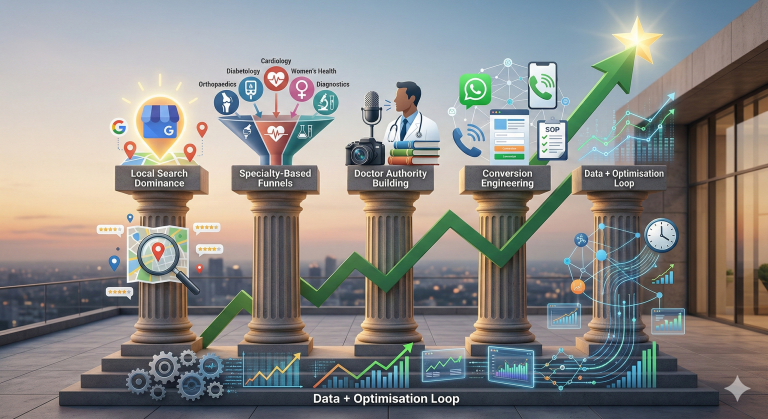
The 5-Pillar Hospital Growth Framework
To build a sustainable digital patient acquisition system, hospitals must implement:
1. Local Search Dominance
Google Business Profile optimisation
Location-specific landing pages
Review acquisition strategy
2. Specialty-Based Funnels
Separate campaigns for:
Orthopaedics
Diabetology
Cardiology
Women’s Health
Diagnostics
Each specialty needs its own acquisition funnel.
3. Doctor Authority Building
Educational video content
Condition-based blog publishing
Reputation management
Media positioning
4. Conversion Engineering
Landing page optimisation
WhatsApp automation
Call tracking systems
Appointment workflow SOP
5. Data + Optimisation Loop
Weekly campaign audit
Monthly ROI analysis
Funnel refinement
Revenue mapping
Final Insight
Hospitals in South India are not struggling because digital marketing does not work.
They struggle because they do not implement it as a system.
A predictable patient acquisition system requires:
Strategy.
Structure.
Measurement.
Consistency.
When implemented correctly, digital becomes the most scalable and controllable growth engine for any hospital.
If you are looking to build a measurable hospital growth framework instead of running random campaigns, the shift must start with systems — not ads.

Authored By Dev Jayakumar
With 15+ years in digital marketing, he has trained 1,000+ students and helped 100+ brands across India, the UK, and Canada grow online. From managing ₹100 Cr+ in ad spends to building performance-driven strategies, he focuses on delivering real, measurable results. He loves to share his knowledge and insights through blogging.