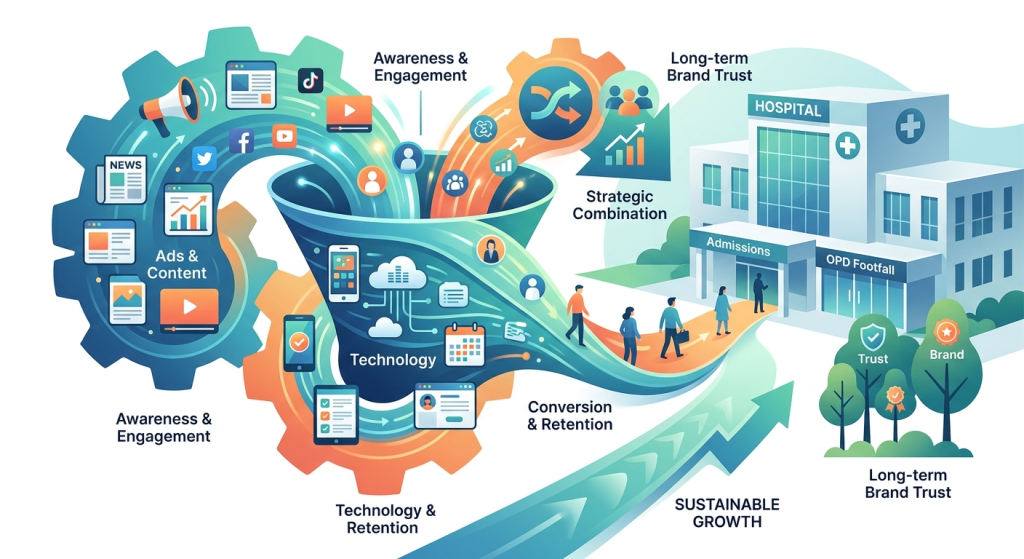
In today’s healthcare landscape, patient acquisition is no longer about visibility alone. Hospitals that consistently grow their OPD and IP admissions follow a structured, data-driven funnel — one that moves a potential patient from awareness to trust to action.
This isn’t theory. It’s a proven framework used by high-performing hospitals to generate predictable patient inflow.
1. Awareness: Winning Attention in a Crowded Market
At the top of the funnel, your objective is simple: be seen by the right audience at the right time.
Most hospitals make a critical mistake here — they focus only on promotions. But awareness in healthcare is built through education and relatability, not just advertising.
What works:
- Short-form health videos (symptoms, early signs, myths)
- Condition-based content (e.g., kidney health, urology issues)
- Localised SEO blogs targeting high-intent searches
- Social media reels with doctor presence
Key Insight:
Patients don’t search for hospitals first — they search for symptoms and solutions.
If you don’t show up there, you’ve already lost them.
2. Consideration: Building Trust Before the First Visit
Once attention is captured, the next stage is trust-building. This is where most conversions are won or lost.
Healthcare decisions are emotional and risk-sensitive. Patients look for proof, reassurance, and credibility.
What works:
- Patient testimonial videos (high impact)
- Doctor-led educational content
- Before/after or recovery stories
- Google reviews and ratings visibility
- FAQ-based content addressing fears and doubts
Key Insight:
A patient is not asking, “Which hospital is best?”
They are asking, “Can I trust this hospital with my problem?”
3. Conversion: Turning Interest into Appointments
At this stage, the patient is ready — but friction can kill conversions.
Hospitals often lose leads due to:
- Slow response times
- Complicated booking processes
- Lack of clear call-to-action
What works:
- Click-to-call and WhatsApp integrations
- Instant response systems for enquiries
- Dedicated landing pages for specialties
- Clear CTAs like “Book Consultation” or “Talk to a Specialist”
Key Insight:
Speed is critical. The hospital that responds first often wins the patient.
4. Experience: From OPD Visit to Admission
Your funnel doesn’t end at booking — it extends into the hospital experience.
A seamless experience can convert:
- OPD → IP admission
- One-time patient → long-term loyalty
What matters:
- Front desk efficiency
- Doctor-patient communication
- Waiting time management
- Clear treatment explanation
Key Insight:
Marketing brings the patient in. Experience decides revenue.
5. Retention & Advocacy: The Hidden Growth Engine
Most hospitals ignore this stage — and lose exponential growth.
Satisfied patients can become:
- Repeat visitors
- Referral sources
- Brand advocates
What works:
- Post-treatment follow-ups
- Feedback collection systems
- Encouraging reviews/testimonials
- Health awareness re-engagement campaigns
Key Insight:
One happy patient can bring 5–10 new patients without additional marketing spend.
The Complete Funnel at a Glance
Awareness → Trust → Conversion → Experience → Advocacy
Hospitals that optimise all five stages don’t rely on random walk-ins — they build a predictable patient acquisition system.
Final Thought
The future of hospital growth is not in isolated campaigns, but in integrated funnels.
- Ads alone won’t work
- Content alone won’t convert
- Technology alone won’t retain
But when combined strategically, they create a system that consistently drives OPD footfall, admissions, and long-term brand trust.
If hospitals want sustainable growth in 2026 and beyond, the question is no longer:
“How do we market?”
It’s:
“How do we build a funnel that patients naturally flow through?”