Introduction
Sales and customer support are undergoing a massive transformation with the rise of AI-powered telecallers and voice assistants. These tools leverage Natural Language Processing (NLP), speech recognition, and machine learning to automate calls, qualify leads, and even assist human agents in real time.
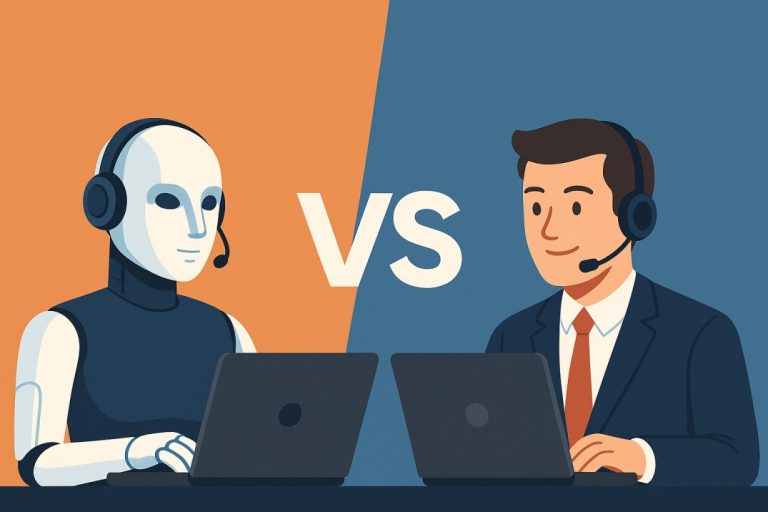
But the big question remains: Will AI replace human telecallers entirely? Or will it act as a force multiplier, making sales teams more efficient?
In this blog, we’ll explore how AI telecallers work, their real-world impact, and whether sales professionals should see them as a threat or a powerful ally.
1. How AI Telecallers Work
AI telecallers (or voice bots) are designed to: Automate outbound calls (appointment reminders, payment collections, lead follow-ups). Handle inbound queries (customer support, FAQs). Analyze conversations in real time (sentiment detection, objection handling).
Popular AI Telecaller Tools:
Haptik – AI voice bots for sales and support.
Exotel – Cloud telephony with AI automation.
Skit.ai – Specializes in collections and customer engagement.
Uniphore – Real-time call analytics and agent assistance.
Amazon Lex / Google Dialogflow – Customizable AI voice assistants.
These tools use speech-to-text (STT) and text-to-speech (TTS) to simulate human-like conversations while integrating with CRMs like Salesforce and HubSpot for seamless lead management.
2. Can AI Replace Human Telecallers?
 Where AI Excels:
Handling high-volume, repetitive calls (e.g., payment reminders, lead screening).
24/7 availability (no breaks, no fatigue).
Data-driven insights (call analytics, customer sentiment tracking).
 Where Humans Still Dominate:
Complex negotiations (B2B deals, high-ticket sales).
Emotional intelligence (building trust, handling objections with empathy).
Adaptability (unscripted conversations, humor, personalization).
Verdict: AI won’t fully replace sales reps but will automate mundane tasks, allowing humans to focus on high-value interactions.
3. AI as a Real-Time Sales Assistant
The best use case for AI is augmenting human agents, not replacing them.
Example Case Study: How AI Supercharged Sales at XYZ Corp
Company: XYZ Corp (Mid-sized SaaS Business)
Challenge:
High lead volume but low conversion rates.
Sales team overwhelmed with cold calls & follow-ups.
Inconsistent pitch delivery due to human fatigue.
Solution:
Implemented AI-powered telecaller (Skit.ai) for initial lead qualification.
Used real-time AI assistance (Uniphore) to guide human agents during calls.
Integrated with CRM (Salesforce) for seamless lead tracking.
Results in 6 Months: 40% increase in lead conversion (AI filtered out poor leads early). 30% shorter call durations (AI suggested quick, accurate responses). 15% boost in sales team productivity (fewer repetitive tasks). Improved customer satisfaction (AI detected frustration, escalated to humans).
Key Takeaway:
AI didn’t replace XYZ’s sales team—it made them faster and smarter.
4. The Future: AI + Human Collaboration
The most successful sales teams will adopt a hybrid approach:
AI for: Lead screening, follow-ups, data insights.
Humans for: Relationship-building, closing deals, handling objections.
How to Prepare?
Upskill telecallers to work alongside AI tools. Use AI for analytics to refine sales strategies. Focus on high-touch selling where human connection matters.
Conclusion: AI is an Ally, Not a Replacement
AI telecallers are revolutionizing sales, but they won’t make human agents obsolete. Instead, they’ll: Eliminate grunt work (so reps focus on selling). Provide real-time insights (making calls more effective). Enhance customer experience (faster responses, smarter interactions).
The future belongs to AI-augmented sales teams—not pure automation.
What’s Your Take?
Do you think AI will eventually replace telecallers? Or will it always need a human touch? Let me know in the comments!