Digital marketing has become unavoidable for hospitals.
Google Ads, Meta campaigns, Instagram reels, YouTube videos—everything promises visibility, leads, and growth.
Yet, when hospital leadership asks a simple question
“How many actual patients did digital marketing bring this month?”
—most marketing reports fall silent.
Clicks, impressions, reach, and leads are easy to present.
Consultations, admissions, and revenue are harder to measure—but that’s where real ROI lives.
This gap between marketing activity and business outcomes is where many hospitals lose clarity, confidence, and often money.
The Fundamental Problem: Hospitals Measure Activity, Not Impact
Most hospital marketing dashboards focus on:
- Website traffic
- Ad impressions and clicks
- Cost per lead (CPL)
- Social media engagement
These metrics show effort, not effectiveness.
A hospital does not grow because it generated:
- 10,000 impressions
- 800 clicks
- 150 enquiries
It grows because:
- Patients walked in
- Consultations happened
- Treatments were delivered
If digital marketing data does not connect to patient movement, ROI will always feel unclear.
Why “Leads” Are a Misleading Metric in Healthcare
In healthcare, not all leads carry the same intent.
A WhatsApp message saying “Just checking consultation fees”
is very different from a phone call saying “Doctor suggested surgery, need a second opinion urgently.”
Yet, in most reports, both are counted as one lead.
This creates three serious problems:
- Marketing teams optimise for volume instead of intent
- Management loses trust in digital marketing performance
- Budget decisions are made using incomplete signals
Hospitals don’t need more leads.
They need better lead qualification and attribution.
The Real Funnel: Clicks → Conversations → Consultations
To measure true ROI, hospitals must stop thinking like advertisers and start thinking like service systems.
The real patient journey looks like this:
- Click – Ad, Google search, social media
- Conversation – Call, WhatsApp, website form
- Consultation – OPD visit or teleconsult
- Conversion – Treatment, procedure, admission, or follow-up
Most hospitals measure only Steps 1 and 2.
ROI begins at Step 3.
Real-World Scenarios Hospitals Quietly Struggle With
High Leads, Empty OPD
A mid-sized multi-speciality hospital generated 300+ digital enquiries per month.
Marketing reports looked healthy, but OPD footfall remained flat.
A review revealed:
- Calls, WhatsApp messages, and website forms were tracked separately
- Walk-in patients were never linked back to digital sources
- Front-desk teams lacked enquiry prioritisation
When enquiries were mapped to actual consultations, only about one-fifth resulted in OPD visits.
The issue wasn’t marketing—it was broken tracking and follow-up.
Cheap Leads, Expensive Reality
Another hospital proudly reported a very low CPL.
Yet revenue growth did not match expectations.
On analysis:
- Most leads were early-stage or casual enquiries
- Very few were consultation-ready
- No metric existed for cost per consultation
Once campaigns were optimised for high-intent actions (calls and appointment-focused forms), lead volume reduced—but consultations and revenue increased.
WhatsApp Was the Best Channel—But Invisible
In one case, WhatsApp was generating a large share of patient enquiries.
However:
- Messages stayed on individual phones
- No central record existed
- No conversion data was available
Once WhatsApp enquiries were logged centrally, leadership discovered that WhatsApp had the highest enquiry-to-consultation ratio—a critical insight that had gone unnoticed.
Walk-ins Were Ignored in ROI Calculations
Many hospitals assume walk-ins are “offline” patients.
In reality, many walk-ins:
- Saw an ad
- Googled the hospital
- Messaged on WhatsApp
- Then walked in directly
Because front desks never asked “How did you hear about us?”, digital ROI was consistently underreported.
A single intake question changed the entire perception of digital marketing impact.
What Hospitals Should Measure Instead (Real ROI Metrics)
1. Enquiry-to-Consultation Ratio
This shows how many enquiries convert into actual consultations.
It reveals:
- Lead quality
- Front-desk effectiveness
- Campaign intent accuracy
2. Cost per Consultation (Not Cost per Lead)
A ₹200 lead that never visits is expensive.
A ₹1,000 lead that converts into treatment is profitable.
Hospitals must move reporting from:
Cost per lead
to
Cost per consultation
3. Source-wise Patient Attribution
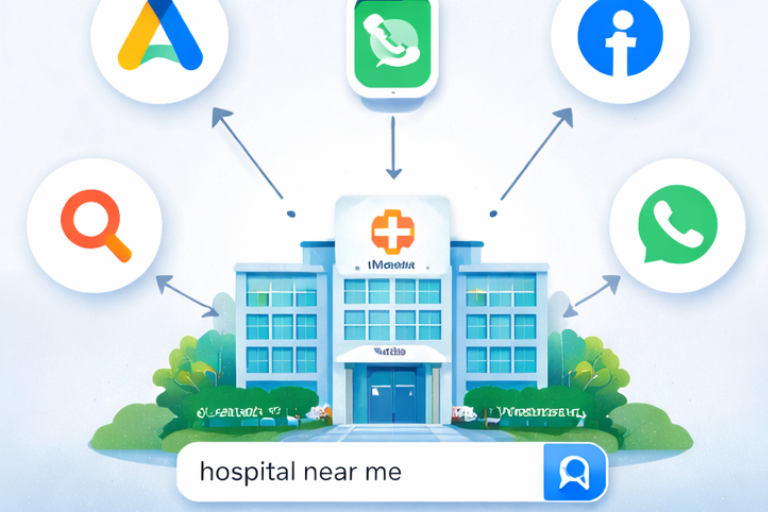
Hospitals should track not just leads, but patients by source:
- Google Ads
- Meta Ads
- Organic search
- Direct walk-ins
This clarity drives smarter budget allocation.
4. Department-wise ROI
Different departments behave differently:
- Urology ≠ Orthopaedics ≠ Diagnostics
A single overall CPL hides reality.
Each department needs its own benchmarks and expectations.
The Missing Link: Unified Lead Tracking
Most hospitals struggle with fragmented systems:
- Calls tracked separately
- WhatsApp on personal devices
- Website forms emailed, not logged
- Walk-ins undocumented
Without a single source of truth, ROI will always be an estimate.
What hospitals need:
- Call tracking for enquiry numbers
- Website form tracking
- Centralised WhatsApp logging
- Manual walk-in entry
- One CRM or dashboard connecting everything
When all enquiries flow into one system, ROI becomes visible.
Technology Is Not the Bottleneck—Process Is
The tools already exist:
- Call tracking software
- CRM systems
- Analytics dashboards
- WhatsApp APIs
Yet ROI remains unclear because:
- Enquiry definitions are vague
- Front-desk teams are not aligned with marketing
- Follow-ups are inconsistent
- Reviews focus on leads, not consultations
ROI improves when marketing, operations, and leadership review the same data.
A Leadership Perspective on Digital Marketing ROI
Digital marketing today is no longer a creative function—it is a growth system.
Hospital leaders should stop asking:
“How many leads did we get?”
And start asking:
“How many patients did digital marketing bring, and what did it cost per consultation?”
When this shift happens:
- Marketing becomes predictable
- Budgets become defensible
- Decision-making becomes data-led
- Trust between management and marketing improves
Final Thought: Measure What Moves the Hospital Forward
Clicks don’t heal patients.
Impressions don’t fill OPDs.
Leads don’t guarantee consultations.
Hospitals that succeed digitally are not those who advertise more—but those who measure better.
If digital marketing ROI feels unclear, the solution is rarely more ads.
It is better tracking, better alignment, and better questions.
Because in healthcare, digital marketing doesn’t fail loudly—it fails invisibly.